
Cathedral Choristers perform at Wigmore Hall

As part of our 500th Anniversary Celebrations, the Cathedral Choir performed at Wigmore Hall on 5th January with a recital program tracing a remarkable multi-century arc of English choral music, beginning with John Taverner’s early 16th-century works Christe Jesu, pastor bone Weston Wynde Mass. Taverner is among the most significant composers of the early Tudor church and was also the first appointed Organist of the Cathedral. His music laid foundations for English polyphony with its rich, flowing lines and deep spiritual resonance.
In the second half, the programme moved through the 20th century with William Walton’s Make we joy now in this fest and Peter Warlock’s carol Bethlehem Down, pieces that reflect the distinctively English synthesis of folk-influenced lyricism and modern harmonic language. Simon Preston’s There is no rose bridges old and new, renewing medieval textural traditions in a contemporary idiom, while Giles Swayne’s Magnificat and Errollyn Wallen’s of her Magnificat (of which this concert was also the London première) brought a distinct, contemporary flourish to the program.
Closing with another Taverner motet, Mater Christi sanctissima, the programme not only celebrated five centuries of choral tradition specifically related to Christ Church but underscored how this lineage continues to inspire living composers.
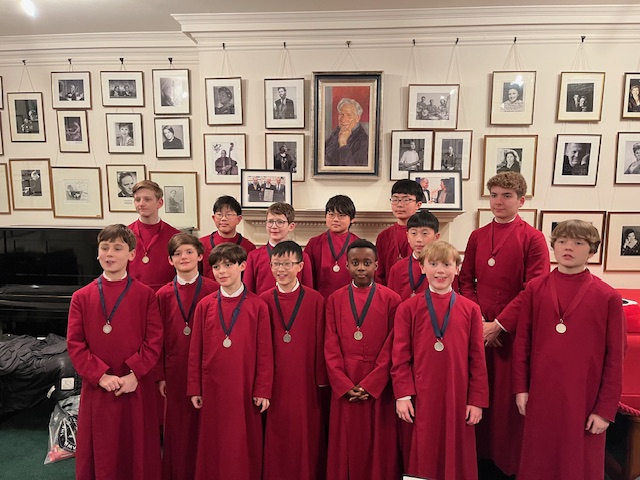
Wigmore Hall in London is one of the world’s most celebrated venues for chamber music seating up to 545 audience members. As a result, the hall is renowned for its crystalline acoustics and intimate atmosphere. Built in 1901 and located in the heart of the West End, it was originally named Bechstein Hall (as it was built by the German piano manufacturers). Owing to anti-German sentiment, the name was changed to Wigmore Hall in 1917 (following its seizure by the British Government in 1916).
Over its history, Wigmore Hall has become a revered platform for premieres, historic performances and the celebration of vocal and instrumental excellence. Whilst many building around it were damaged during World War 2, Wigmore Hall came out unscathed and therefore retains all its original architectural and decorative features. Particularly noteworthy is the building’s Renaissance Revival style and the ceiling artwork in the hall depicting ‘The Soul of Music’.