Latin for Philoglots
It is unlikely to happen, of course; but if one day the Prime Minister should take me aside and say, “Richards, I would have you design a Rational Curriculum that shall be for All Schools – yea, even unto the Sector hight Independent,” I should spring to the mission with alacrity; and aside from reinstating Carpentry, and making space for Architecture and Astronomy, Botany and Geology, I should institute from Years 5 to 8 a regular lesson called Language.
Language?! I hear you and the PM cry. Whatever would that involve?
I am glad you ask. In Language children would learn about the nature and workings of language in perspectives scientific and historical and philological and philosophical. Questions that would be raised (and sometimes answered) might include Does our mother tongue affect the way we think? Why is we hair-trigger sensitive to grammatical slips yet stumble in grammar tests? How come in toddlerhood we learn our first language with easy rapidity, yet acquiring another after our first decade is (for many of us) strugglesome? Why do we put our verbs in the middle while Japanese and Turk are happy to put their verbs at the end? What do other animals think of our tendency to pass hours in inconsequential talk? What on earth is ablaut?
And so on… A list of all the possible linguistic topics would burst the virtual seams of this electronic bulletin. But no, the Prime Minister is unlikely to ask: he has too many urgencies in his in-box. Why then raise our educational hopes in one excitingly italic paragraph, you exclaim in tearful frustration, only to dash them in the next and blame it on the Prime Minister! Yet be not dismayed. Language is already studied here by way of a subject long in place: Latin.
Elementary Latin can be an effective tool to learning about language. It is to linguistics as lego to architecture, meccano to engineering. The attentive pupil learns with Latin how the building blocks of sentences fit together in regulated fashion; that the verb is the crux of the clause; how adjectives ‘agree’; the neat way endings convey a noun’s function in a sentence. And Latin’s alphabet is used in a friendly phonetic fashion, helpful to poor spellers – unlike many a language I could mention. (Yes, I’m looking at you, Welsh.) Latin – at least the Latin we mostly do in school – is grammatically transparent, like those anatomical models that help students identify the internal organs of the body.
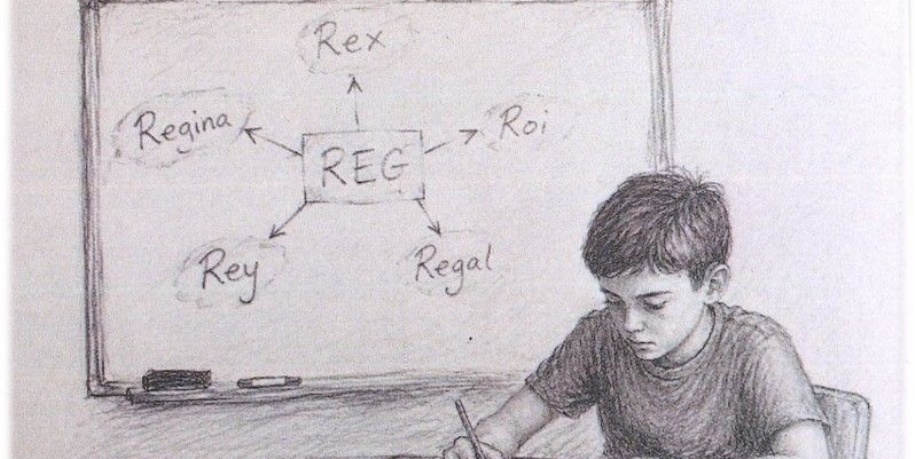
If linguistic training is the end, it may be objected, why not construct a quite regular artificial language with no grammatical or semantic ambiguity? That could be done; but we should miss out on other benefits of Latin. English vocabulary contains thousands of words derived directly and indirectly from Latin. (Half of the dozen words in the preceding sentence come from Latin, for instance.) The curious pupil often makes surprising and arresting discoveries of English’s debt to Latin. (‘Who would have thought that wall, very nice and street come from Latin?!’ he exclaims happily. ‘Now I know why the noun formed from propel is propulsion,’ he nods with academic satisfaction. ‘Ah, so that’s what connects tangent, tactile and tango!’ he mutters to himself, now that others in the class have told him to pipe down.) And should he wish to learn Latin’s daughters Italian and Spanish (and he really should) he will find his Latin has set him up muy bien – or even ottimamente.
Another cogent reason to prefer Latin above some artificial lingo is that it is a venerable language, deep-rooted in our culture; a language amplified and refined by literary luminaries Cicero and Virgil, spun with artful design by the sophisticated Horace and Ovid; for centuries the lingua franca of Europe, and still with us in motet, motto and maxim. Our Latin-literate alumnus may well find his knowledge in keen demand by unLatined mediaeval historian or by young students of old literature, puzzled by strands of Latin in Milton and Marlow. Some of our pupils will take Latin far enough to read the very words of Virgil and Horace – something you need to achieve before you fully understand why it is worth achieving; but even those whose struggles with the tongue of Caesar end when they leave us will have gained, even if unconsciously, some insight into language in general and some awareness in particular of the significance of Latin.
Regular readers of this Here’s my subject series may be expecting what-we-do-with-what-book-in-which-year specifics; but it seemed in the case of Latin more worthwhile to address in this forum the why rather than the what, which, when. Nuts and bolts may be found within the school website. (Memo to self: needs updating.)
Regular readers of this Here’s my subject series may be expecting what-we-do-with-what-book-in-which-year specifics; but it seemed in the case of Latin more worthwhile to address in this forum the why rather than the what, which, when. Nuts and bolts may be found within the school website. (Memo to self: needs updating.)
And some may be asking, ‘But what of Greek?’ Ah yes, Greek…! But Greek deserves many pages; and she might with justice feel short-changed to be tacked on in slim paragraph to a eulogy of her younger sister, Latin. Another Newsletter, perhaps. And meantime boys whose aptitude and eagerness in Latin have earned invitation to join Greek Club should be happy to report to the interested what they have learned so far of that influential language.
NR