Science at CCCS
.png)
Science at CCCS is much more than a subject on the timetable and in this article, I hope to explain a bit about what goes on in Darwin, our science lab here at CCCS, and why I believe I have the best job in the school!
We are very fortunate to have a dedicated space for our prep pupils to start their journey as young scientists; this allows numerous opportunities for collaborative, investigative tasks that would not be possible in other settings.
Science for all pupils at CCCS is so important: it fosters natural curiosity, develops critical thinking and aids in building knowledge about the world. It also encourages the development of essential skills like observation, prediction and analysis, that can of course be applied in many contexts.
Science education starts in the nursery where Miss Helen and the team aim to foster the children’s natural curiosity, through hands-on exploration, observation and experimentation in the natural world. In Pre-Prep pupils get more of a formal introduction to science lessons and the lab will often be utilised by them to enhance learning and ensure they are familiar with the setting.
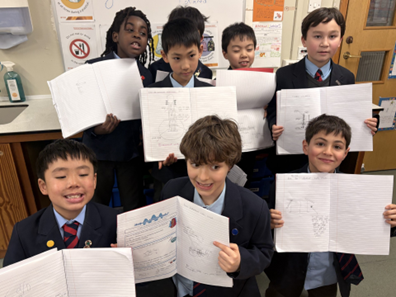
Form 3 boys have their science lessons in the lab with Mrs Green and then from Forms 4 to 8 they are taught by me in Darwin. The curriculum time given to science lessons in the prep school is significant, starting with 3 lessons a week for Forms 3 and 4, building to 4 lessons a week for Forms 5 and 6 and finally 6 lessons a week once boys reach Forms 7 and 8. Science lessons are an equal mix of theory-based lessons and more practical sessions. The acquisition of enquiry skills is paramount to the development of our pupils as confident scientists. The spiral nature of the science curriculum means that subject areas are revisited year after year at a slightly more advanced level as pupils progress up the school. Looking through their books, it is clear to see the progress made from year to year, and I am always delighted that boys leaving us in Form 8 do so not only with fantastic subject knowledge but also the curiosity and investigative skills needed to progress successfully in their next schools.
Pupils are constantly encouraged to make links with other curriculum areas and realise that science is all around them, not just a lesson that happens in the lab. Form 4 were very excited recently to link their enthusiasm and knowledge of the musical instruments they play with their understanding of sound and how sounds are made by the various instruments. Their enthusiasm for this task was a delight to see and truly a credit to our music department and fabulous peris!
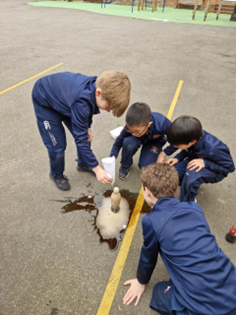
Outside of the lab, we enjoy taking advantage of our location to offer a variety of science focused visits over the year that support the curriculum and help bring it to life for our pupils. In recent years, science enrichment opportunities have included visits to the Science Oxford Centre in Headington, the Oxford Museum of Natural History, the History of Science Museum, the Cotswold Wildlife Park and Crocodiles of the World… to name but a few!
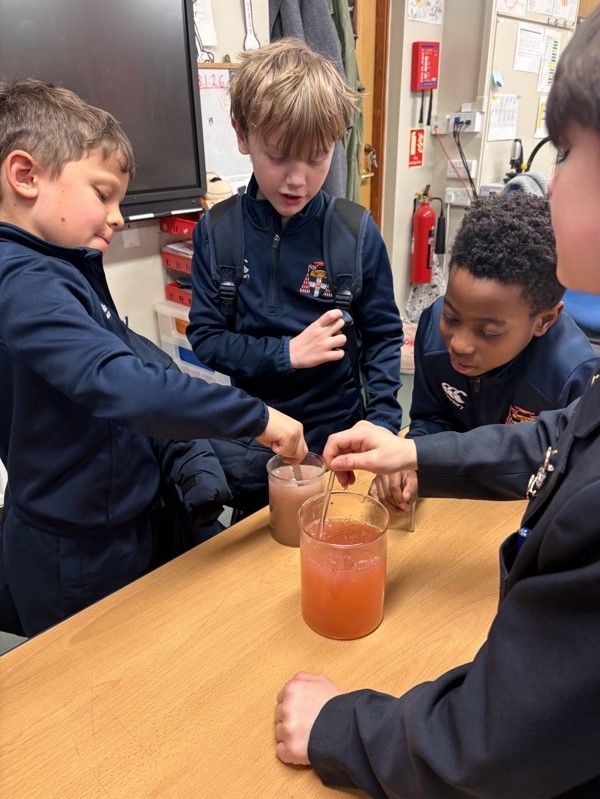
I love coming to work every day: the boys I teach are curious and enthusiastic and not scared to ask too many questions or make mistakes because we are enabling them the freedom and opportunity to be tenacious, interested and to explore the world in their own way. At the end of a recent lesson about dissolving, some members of Form 5 asked if they could mix all the substances we had tested together. (Rest assured I would probably not have permitted this in a Form 8 lesson about acids and alkalis!) They then proceeded to spend 10 minutes of their break time mixing various solids and liquids with the aim of discovering their very own element. Much discussion about which boy the new element would be named after ensued, so it was probably for the best that nothing more than a sludgy pink concoction was created along with a sense of fun and autonomy over their own learning!
Mrs Charlotte Simpkins
Head of Science
Form 5 Tutor