Summer term is in full swing!
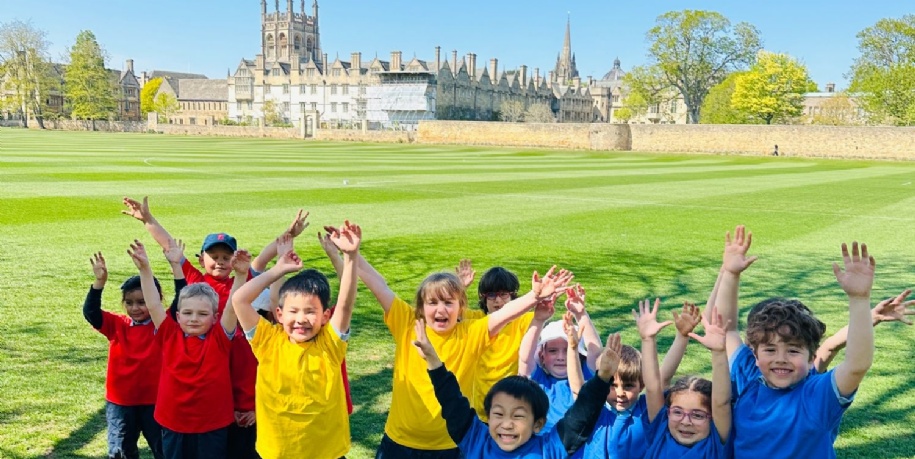
It has been lovely to see everyone back over the last three days. Oxford looks utterly magnificent; the
Meadow is full of cowslips and tulips and, all around us, that bewitching combination of buildings
and gardens has turned Oxford into a worldly paradise. It’s unsurprising, therefore, that there seems
to be a real atmosphere of positivity about the place and I’m looking forward to this term hugely.
One parent said to me this morning that she always associated this time of year with the excitement
of going back to school for the summer term that she felt when she was a child. I know exactly what
she means!
One of the first things I did this term was to go on a conference with Mrs Fairhurst at Winchester
College. It was a conference about assessment, in particular the assessment of writing. AI allows us
to do things rather differently. Research that was quoted suggested that if young people are given
an exam, and half of them are able to do the exam on paper and the other half on a computer, on
average, those who did the exam on paper perform 6% better than those using a computer. This is
fascinating information, suggesting that we should try to retain the completion of exams for most
pupils by hand. Having said that, what is also clear is that AI could make a huge difference in terms
of marking and assessment. Firstly, there is a clever AI program which will transform handwriting
into typescript very quickly. Once this has been done, it allows the work to be processed by AI. The
marking system that we heard about works in the following manner. Large numbers of experienced
markers were asked to arrange pieces of writing in order of quality. The results are then pulled
together by AI and an overall order is produced. At the same time, markers are able to produce voice
note comments upon individual pieces which then can be compiled, and sophisticated comment
summaries on each piece produced. If multiple pieces from the same school are marked, then the
the Artificial Intelligence is able to compile a summary upon the characteristics of work produced by
the school as a whole. This seems to me to be a profoundly useful tool and a remarkable application
of artificial intelligence.
We also had a staff INSET day during which we had a visit from a primary school teacher from
Manchester known as Mr P who is a well-known social media personality. He advocated the
responsible use of AI and information technology. He showed us some of the remarkable things that
can now be done in a classroom. He showed us a remarkable example of one of his pupils who had
super imposed himself upon a battlefield and was giving, wearing complete military garb, a rousing
speech as if he was starring in the film Braveheart! It is intriguing to see how profoundly various
technologies can enhance teaching.
Next week, we are hosting the annual conference of the Choir Schools Association. There are three
choir schools in the southern hemisphere and three choir schools in Oxford and there are more
members of the Choir Schools Association in this city than in any other in the country, including
London. As part of the conference, the delegates will be attending choral evensong recorded live in
Christ Church Cathedral to mark the 500 anniversary of the foundation of the choir in 1526. This will be
at 3 o’clock on Radio Three. The podcast also marks the 100th anniversary of the broadcasting of
Choral Evensong on the BBC, making it the longest running live broadcast programme in the world.
You are of course very welcome to attend the recording but must be seated in the Cathedral by
2.30pm. Alternatively, I would encourage you to listen on the Radio at 3.00pm. The Worcester and
Pembroke choirs will also be singing to all the conference delegates on Thursday morning in a
combined choir. None of the other members attending the conference have three college choirs in
their school. We are unique and it will therefore be particularly gratifying to host the important
gathering.
Yesterday I brought our very elderly dog Trebetherick into school again. I am certain that, despite his shortness of sight and hardness of hearing – he is almost 17 – after all that he realises the extraordinary responsibility of being the Headmaster‘s dog. He stands proudly on Brewer Street accepting the adoration of the many pupils who stop to say hello. On Thursday, a young girl was particularly attentive. “Daddy,” she said in an excited tone, “Can we peck him?” “I think what you mean is can we pet him.” “No Daddy, I want to peck him.” She carefully put her hand on top of her father’s. “Your hand and my hand! We can peck him together.” The father started to stroke Trebetherick, his daughter‘s tiny hand placed on his. Eventually she slipped her hand down and, with the greatest courage, started to touch his coat. She seemed very excited – I expect it made her day. What I do know for certain is that it made Trebetherick’s. He looked like a new dog!