History at CCCS
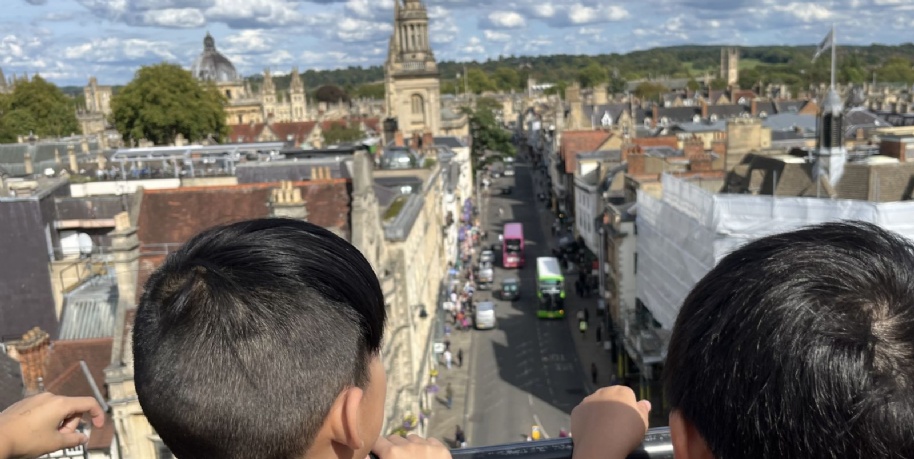
A funny thing happens in a place like Oxford. The past, it seems, stands still. The buildings of its skyline were built so long ago that they never seem to have been built at all, but rather form a mountain range of unlit gothic caves, crocketed spire peaks and ranks of roosting gargoyles, beneath which sprawls a subterranean warren of quads and colleges – inhabited of course, by undergrads, indistinguishable from the average denizen of the Misty Mountains.
It’s easy to imagine that, in a place so rich with history, understanding it would be like breathing, yet it can also be like the air: as invisible as it is ubiquitous. Having grown up and gone to school in Oxford myself, it’s remarkable how a child can take this place for granted. As kind as it is of the past to stand still and give us all a chance to take a proper look, you quickly forget that it was ever moving to begin with; the four centuries and change since Christ Church’s construction soon becomes another number. Six lifetimes thereabouts – I find this to be a much more intuitive way of looking at it. A lot can happen in one lifetime, let alone a half-dozen, and yet it still feels oddly fleeting that only six lives would fit in just under half of a millennium.
How at CCCS do we convey this contrast? How do we teach the boys that history was once a dynamic world far apart from ours, inhabited by lives as human as yours or mine, and yet it is also set in limestone all around us? How do we show that only from this oxymoron was our modern world born? Firstly, we use the resources which we are lucky to have upon our doorstep. For ten years now, my colleague Mr Richards has sought to impart a deeper understanding of Oxford’s past through stunning architecture, running across various terms the Architecture Club, a noble cause also joined in by another extracurricular activity: Making the Most of Oxford. Oxford’s architectural history is only static if you don’t have someone to tell the stories behind it. Having worked here for just over a year now, the amount of historical knowledge available to anyone who would ask is extraordinary.
The wealth of history available outside the curriculum is only half the story though. Prep schools nationwide find themselves in a predicament. British history, as taught by many senior schools, begins in 1066 and follows neatly through the Middle Ages to the Tudors, then the Stuarts and the Civil War, skips these isles during the eighteenth century in favour of their growing empire, then returns in time for the Victorians and two world wars. A great number of our students will be picking up this story in Year 9, dedicated by most schools to the twentieth century. When creating our own curriculum then, the challenge is to avoid condemning the boys to endless repetition in a few years’ time by stepping on the toes of common Year 9 or GCSE topics, but also to create a clear narrative; at the heart of a child’s enjoyment of history is the storytelling. To this end, the Prep School begins its study in Stone Age Britain. After a term’s detour through Ancient Egypt – a period of beautiful and mysterious artefacts that lends itself perfectly to tactile exploration by those just beginning to approach history as an academic subject – the story follows Britain’s succession of invaders: Celts, Romans (preceded by a module on the Ancient Greeks as Roman culture wouldn’t make sense without it), Saxons, Vikings, and of course the Normans. The older boys learn about the High Middle Ages, into the Early Modern Period. Natural opportunities to look abroad are found throughout, whether it’s the Crusades, the Age of Exploration, or the British Empire. By the time they leave Form 8, the hope is that the boys will be able to draw a coherent line from the Stone Age into the time periods they will be studying in Year 9. In this way, they will also be equipped to contextualise their GCSE studies should they choose to continue history beyond Key Stage 3. Common topics at this level include medicine through time, tracing the development of healthcare from Aristotle, Galen and the humours, through to Watson, Crick and DNA. Needless to say, this is easier to follow with a robust understanding of what is going on outside the hospitals. Above all else, it is this ability to contextualise that is the goal of history teaching at CCCS.
Mr Pedr Davies
English & History Teacher